

NEW FEATURE! The Only Platform That Knows Which 3% of Homeowners Are Most Likely to Buy

Elementor #1421

OWN ANY NEIGHBORHOOD

This One Trait Predicts
Who Wins The Business

Homeowners don't hire the first company they see. They hire the one they've seen the most. Here's how to engineer that advantage — systematically.

KEY TAKEAWAYS

Pick the right neighborhoods.

Focus where you've already done work — stable homeowners, matching job types, active community groups. That's where your marketing compounds

Engineer repetition — don't leave it to chance.

Set up automations triggered by job events. Consistent exposure moves homeowners from "I've seen them" to "I trust them."

Use hyperlocal personalization.

"We just completed a job on Maple Street" increases relevance, memory, and response rates instantly.

Capture a review immediately after the job.

A fresh review becomes your foundation for neighborhood social proof.

Leverage neighborhood social proof.

One genuine neighborhood post often creates multiple additional touches for free.

Stay visible even when you're busy.

Companies who win neighborhoods keep presence steady all year — especially during peak months

Stop Marketing The Hard Way

Most home service pros are doing their marketing backwards.
They spread themselves thin across an entire city.

Big

Service Area

Big

Radius

Big

Wasted Budget

It feels like the path to more leads. It's actually the slowest way to scale.

You'll grow faster — and far more profitably — by saturating specific neighborhoods and becoming the name homeowners repeatedly see, recognize, and trust.

Because homeowners don't hire the first company they see. They hire the one they've seen the most. And that recognition doesn't happen by accident.

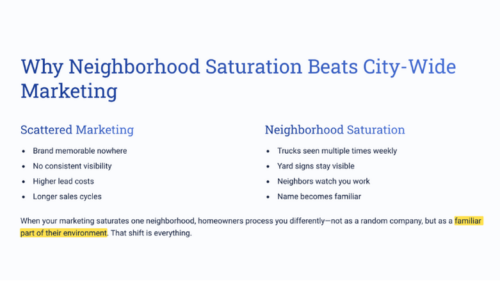
Why Neighborhood Saturation Beats City-Wide Branding Every Time

When your marketing is scattered across a huge radius, your brand becomes memorable nowhere. Homeowners don't see you consistently. They don't form mental associations. They don't recognize you.

But saturate one neighborhood — and suddenly everything compounds:

Their brain starts processing you differently. Not as a random company — but as a familiar part of their environment. That shift is everything.

The Science Behind Why the 7-Touch Rule Actually Works

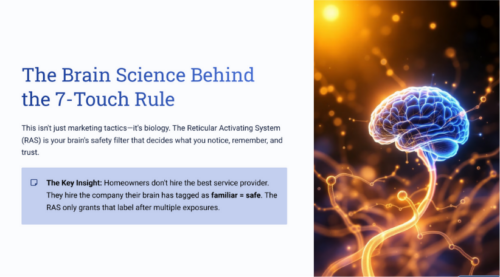
Most people think the 7-touch rule is a marketing tactic. It's not. It's biology — specifically, how the brain decides who is "safe." The human brain has a built-in safety mechanism called the Reticular Activating System (RAS) — the filter that decides what you notice, remember, and ultimately trust.

Homeowners don't hire the best service provider. They hire the company their brain has tagged as familiar = safe. And the RAS only grants that label after multiple exposures.

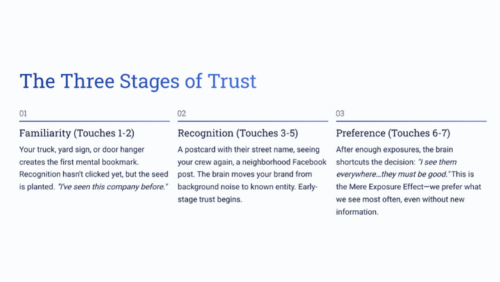
The Three Stages to "Approved"

STAGE 1

TOUCHES 1 - 2

Familiarity

Your truck. Your yard sign. A wave at the door. These create the first mental bookmark. Recognition hasn't clicked yet — but the seed is planted.

"I've seen this company before."

STAGE 2

TOUCHES 3 - 5

Recognition

A postcard with their street name. Seeing your crew again. A post in the neighborhood Facebook group. The brain moves your brand from background noise to known entity.

Early stage of trust begins.

STAGE 3

TOUCHES 6 - 7

Preference

The brain shortcuts the decision. This is the Mere Exposure Effect — we prefer what we see most often, even without new information. Their brain has already decided before they compare quotes.

"I see them everywhere… they must be good."

Why Most Contractors Fail to Build Trust

Most pros stop after Touch #1. They show up. They do great work. They might have a wrapped truck or nice shirts. But if they don't follow up with touches 2–7, the neighbor forgets them the moment the truck leaves the street.

"This is a repetition problem,
not a quality problem."

If you want to dominate a neighborhood, you need two things:

  1. A tight area you’re committed to showing up in
  2. A system that delivers all seven touches automatically

That’s the difference between pros who chase jobs city-wide and pros whose schedules fill months in advance inside one neighborhood.

The 5-Step Neighborhood Domination System

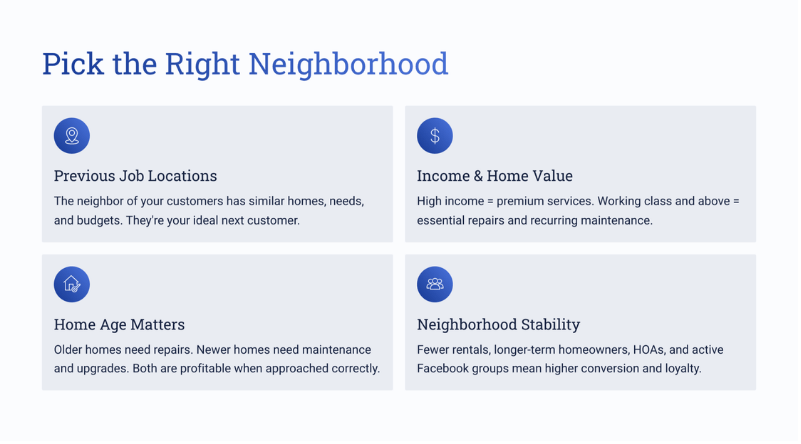
Pick the Right Neighborhood

The neighbor of your customers is more like your ideal customer than anyone else in the city. They have similar homes, similar needs, similar budgets. Look for:

Stable neighborhoods convert higher, stay loyal longer, and generate more repeat jobs. These are your gold mines.

Automate the Repetition (Touches 3–7)

This is where SendJim + your CRM handle the heavy lifting.

AUTOMATION TRIGGER FLOW

JOB SCHEDULED → Neighbor postcards sent immediately

JOB COMPLETED → Second neighbor postcard drop

INVOICE PAID → 6-month reminder drip sequence triggers

All timed. All targeted. All automatic. Automation isn't replacing human connection — it's engineering the repetition the brain requires to move from familiarity → recognition → preference.

Capture a Review Automatically

The homeowner is happiest immediately after service. Their feedback is emotionally charged, honest, and becomes the backbone of your neighborhood social proof. SendJim's Review Management Tool (powered by NiceJob) automates the entire process:

Leverage Neighborhood Social Proof

Ask your customers to post in local groups — Nextdoor, neighborhood Facebook pages, HOA chats. A single authentic post can create ten more touches instantly. Offer a small incentive — like $25 off their next service — for customers who share their experience. Peer-to-peer recommendations almost always outperform paid ads.

The Result: You Become the Default Choice

When homeowners see you seven times — through yard signs, trucks, postcards, reviews, neighbor posts, and real presence on their street — something powerful happens.

📉 Price matters less

🏆 Competitors matter less

💰 Lead costs drop

🗺️ Route density increases

📈 Growth accelerates

📞 You're the effortless call

The companies dominating entire neighborhoods aren't lucky. They aren't bigger. They aren't spending more. They simply understand how homeowners make decisions — and they engineer those decisions through familiarity, recognition, and repetition. One neighborhood at a time.

When homeowners need help, they shouldn't be Googling "best roofer near me." They should be thinking: "I see this company everywhere. I'm calling them."

That’s not chance. That’s the 7-touch rule, applied with intention.

Ready to Dominate Your Best Neighborhoods?

SendJim automates every touch — postcards, drips, neighbor targeting, hyperlocal personalization, and review requests — so you can own the neighborhoods that matter most.

This One Trait Predicts Who Wins The Business

Growing inside a neighborhood becomes far easier when you understand how trust is built and how homeowners actually make decisions. Here’s how to apply the 7-touch rule to win more jobs with less marketing effort: 

Key Takeaways:

• Pick the right neighborhoods. Focus on areas where you’ve already done work, with stable homeowners, matching job types, and active communities (Facebook groups, HOAs, Nextdoor). These are the pockets where your marketing compounds the fastest.

• Engineer repetition — don’t leave it to chance. Set up automations that send neighbor postcards, drip reminders, and follow-up touches triggered by job events. Consistent exposure is what moves homeowners from “I’ve seen them” to “I trust them.”

• Use hyperlocal personalization. Details like “We just completed a job on Maple Street” or a recognizable neighborhood landmark immediately increase relevance, memory, and response rates.

• Capture a review immediately after the job. A fresh review becomes your foundation for neighborhood social proof. SendJim’s Review Management (powered by NiceJob) automates the request, the reminders, and the publishing.

• Leverage neighborhood social proof. Encourage happy customers to share their experience in local Facebook groups, HOA pages, and Nextdoor. One genuine neighborhood post often creates multiple additional touches without spending more on ads.

• Stay visible even when you’re busy. The companies who win neighborhoods keep their presence steady all year — especially during busy months when homeowners are most aware and responsive.

• Become the default choice. When homeowners see you 7+ times — trucks, yard signs, postcards, reviews, neighbor posts — you’re no longer “one of many.”
You become the company they already feel confident calling.

Stop Marketing The Hard Way

Most home service pros are doing their marketing backwards.
They spread themselves thin across an entire city…

Big service area.
Big radius.
Big marketing budget.

It feels like the path to more leads – but it’s actually the slowest way to scale.

The truth?

You’ll grow faster (and far more profitably) by saturating specific neighborhoods – the right ones – and becoming the name homeowners repeatedly see, recognize, and trust.

Because homeowners don’t hire the first company they see.
They hire the one they’ve seen the most.

And that recognition doesn’t happen by accident.

Why Neighborhood Saturation Beats City-Wide Branding Every Time

When your marketing is scattered across a huge radius, your brand becomes memorable nowhere.

Homeowners don’t see you consistently.
They don’t form mental associations.
They don’t recognize you.

But saturate one neighborhood…and suddenly:

  • your truck is seen multiple times a week
  • your yard signs stay visible
  • neighbors watch you working
  • postcards hit their mailbox
  • your name pops up in the neighborhood Facebook group

And their brain starts processing you differently.

Not as a random company.
But as a familiar part of their environment.

That shift is everything.

The Deeper Reality Behind Why 7-Touch Rule Actually Works

Most people think the 7-touch rule is just a marketing tactic.

It’s not.
It’s biology – specifically how the brain decides who is “safe”.

The human brain has a built-in safety mechanism called the Reticular Activating System (RAS) – the filter that decides what you notice, remember, and ultimately trust.

So here’s what home service businesses who are serious about scaling need to understand, it’s not just about “being more visible.”
It’s about literally rewiring how the homeowner’s brain perceives your company.
Homeowners don’t hire the best service provider.
They hire the company their brain has tagged as:

familiar = safe

And the RAS only grants that label after multiple exposures.
The brain goes through three stages to be “approved”.

Stage 1: Familiarity (Touches 1–2)
Your truck.
Your yard sign.
A wave at the door.

These create the first mental bookmark.
“I’ve seen this company before.”

Recognition hasn’t clicked yet – but the seed is planted.

Stage 2: Recognition (Touches 3–5)
A postcard with their street name.
Seeing your crew again.
A post in the neighborhood Facebook group.

After a few more exposures, the brain moves your brand from background noise to known entity.
This is the early stage of trust.

Stage 3: Preference (Touches 6–7)
After enough exposures, the brain shortcuts the decision:
“I see them everywhere… they must be good.”

This is the Mere Exposure Effect – the principle that we prefer what we see most often, even without new information.

This is why the neighbor who saw your truck twice, got two postcards, and saw a few people on Nextdoor saying good things…chooses you before they even compare quotes.

Their brain has already decided.

Why Most Contractors Fail to Build Trust

Most pros stop after Touch #1.

They show up.
They do great work.
They might have a wrapped truck or nice shirts.

But if they don’t follow up with touches 2–7…

The neighbor forgets them the moment the truck leaves the street.

Not because the work wasn’t great – but because the brain didn’t get enough exposure to tag the company as familiar.

This is a repetition problem, not a quality problem.

How to Engineer Trust Using Neighborhood Saturation

Once you understand the psychology, the strategy becomes simple.

If you want to dominate a neighborhood, you need two things:

  1. A tight area you’re committed to showing up in
  2. A system that delivers all seven touches automatically

That’s the difference between the pros who chase jobs city-wide…
and the pros whose schedules fill months in advance inside one neighborhood.

It isn’t marketing magic.
It’s memory science.

The beautiful thing when you do this is:

  • Price matters less.
  • Competitors matter less.
  • Lead costs drop.
  • Route density increases.
  • Growth accelerates.

So let’s break down how to do it.

Step 1: Pick the Right Neighborhood

Look for:

  1. Neighborhoods of jobs you’ve completed: The neighbor of your customers is more like your ideal customer than anyone
    else in the city. They have similar homes, similar needs, similar budgets.

  2. Income Level: High income → premium or luxury services
    Working class and above → essential, recurring, and repair services.

  3. Home Value: Often mirrors income patterns from above.

  4. Age of Home: Older homes → repairs Newer homes → maintenance & upgrades

Both can be profitable in different ways

5. Neighborhood Stability Choose areas with:

  • Fewer rentals
  • Longer-term homeowners
  • HOAs
  • Active neighborhood Facebook/Nextdoor groups

Stable neighborhoods convert higher, stay loyal longer, and generate more repeat jobs.

These pockets are gold mines when saturated.

They become even more powerful when your brand shows up repeatedly – the perfect environment for the 7-touch rule to accelerate trust.

Step 2: Automate the Repetition (Touches 3–7)

This is where SendJim + your CRM handle the heavy lifting.

Imagine this happening automatically:

  • Job scheduled → neighbor postcards sent
  • Job completed → neighbor postcards sent
  • Invoice paid → 6 month reminder drip sequence triggers

All timed.
All targeted.
All consistent.
All automatic.

Automation isn’t replacing human connection.

It’s engineering the repetition the brain requires to move from familiarity → recognition → preference.

Step 3: Use Hyperlocal Personalization

This is where the brain lights up. 

When a postcard says: 
“We just completed a job on Maple Street.” 

The homeowner instantly thinks: 
“That’s my street.” 

That micro-second of recognition is enough to: 

  • stop the scroll
  • slow the glance 
  • increase memory 
  • build trust 
  • prime them for the next touch 

Hyperlocal = hyper-effective. 

Step 4: Get a Review Automatically

Reviews are a huge currency of trust. The more reviews you can get in to the areas you want to service, the easier your neighborhood saturation will be.

It’s essential to automate getting a review after every job.

Why?

  • The homeowner is happiest immediately after service
  • Their feedback is emotionally charged and honest
  • And that review becomes the backbone of your neighborhood social proof

Tools like SendJim’s Review Management Tool (powered by NiceJob) automate this entire process:

  • Sending the review request
  • Following up on getting the review
  • Capturing the review
  • Publishing it to Google and Facebook
  • Storing it for future marketing

Once you have the review – it lives forever as a badge of trust to your business. You can even automate sending reviews to the neighbors of whoever left it with the SendJim system to serve as an additional touchpoint.

Step 5: Leverage Neighborhood Social Proof

In addition to asking for a review, it can often be helpful to see if your customers will post in one of the local groups:

  • Nextdoor
  • Facebook neighborhood groups
  • HOA or community chats

A single authentic post can create ten more touches instantly.

Offer a small incentive – like $25 off their service – for customers to share their experience in their local group.

These peer-to-peer recommendations almost always outperform paid ads

The Result: You Become the Default Choice

When homeowners see you seven times – through yard signs, trucks, postcards, reviews, neighbor posts, and real presence on their street – something powerful happens:

You stop being “just another contractor.”
You become the contractor their brain already trusts.

SendJim_Workers_Shakehands

You become:

  • The familiar name
  • The effortless call
  • The company they cmopare everyone else to

Because homeowners typically don’t hire the cheapest bid – they hire the name they feel most confident in.

Confidence comes from petition, not coincidence.

Show up consistently. Automate it. Become the default choice in your service area.

The Bottom Line: This Isn’t Marketing - It’s Memory Engineering

The companies dominating entire neighborhoods aren’t lucky.
They aren’t bigger.
They aren’t spending more.

They simply understand how homeowners make decisions –
and they engineer those decisions through:

  • familiarity
  • recognition
  • preference
  • repetition

One neighborhood at a time.

You don’t need to blanket an entire city.
You just need to become unforgettable in the pockets that matter most.

When homeowners need help, they shouldn’t be Googling
“roof cleaning near me” or “best plumber.”

They should be thinking:

“I see this company everywhere. I’m calling them.”

That’s not chance.
That’s the 7-touch rule, applied with intention.

Ready to Become the Most Recognized Company in Your Best Neighborhoods?

SendJim automates every touch – postcards, drips, neighbor targeting, hyperlocal personalization, and review requests – so you can dominate the neighborhoods you want without doing the work manually.

Start your Neighborhood Domination system by getting a free demo at SendJim.com

Additional Resources for Leveling Up Your Neighborhood Strategy

Want to go deeper?  

🎙 Masters of Home Service Podcast:  
10+ Ways to Turn One Job into the Whole Neighborhood:  
Featuring Daniel Dixon (SendJim CEO) & Keith Kalfas 

Watch on Youtube 
Listen on Apple Podcast

The Identity Trap That Kills Profit

Growing inside a neighborhood becomes far easier when you understand how trust is built and how homeowners actually make decisions. Here’s how to apply the 7-touch rule to win more jobs with less marketing effort: 

Key Takeaways:

• Pick the right neighborhoods. Focus on areas where you’ve already done work, with stable homeowners, matching job types, and active communities (Facebook groups, HOAs, Nextdoor). These are the pockets where your marketing compounds the fastest.

• Engineer repetition — don’t leave it to chance. Set up automations that send neighbor postcards, drip reminders, and follow-up touches triggered by job events. Consistent exposure is what moves homeowners from “I’ve seen them” to “I trust them.”

• Use hyperlocal personalization. Details like “We just completed a job on Maple Street” or a recognizable neighborhood landmark immediately increase relevance, memory, and response rates.

• Capture a review immediately after the job. A fresh review becomes your foundation for neighborhood social proof. SendJim’s Review Management (powered by NiceJob) automates the request, the reminders, and the publishing.

• Leverage neighborhood social proof. Encourage happy customers to share their experience in local Facebook groups, HOA pages, and Nextdoor. One genuine neighborhood post often creates multiple additional touches without spending more on ads.

• Stay visible even when you’re busy. The companies who win neighborhoods keep their presence steady all year — especially during busy months when homeowners are most aware and responsive.

• Become the default choice. When homeowners see you 7+ times — trucks, yard signs, postcards, reviews, neighbor posts — you’re no longer “one of many.”
You become the company they already feel confident calling.

Stop Marketing The Hard Way

Most home service pros are doing their marketing backwards.
They spread themselves thin across an entire city…

Big service area.
Big radius.
Big marketing budget.

It feels like the path to more leads – but it’s actually the slowest way to scale.

The truth?

You’ll grow faster (and far more profitably) by saturating specific neighborhoods – the right ones – and becoming the name homeowners repeatedly see, recognize, and trust.

Because homeowners don’t hire the first company they see.
They hire the one they’ve seen the most.

And that recognition doesn’t happen by accident.

Why Neighborhood Saturation Beats City-Wide Branding Every Time

When your marketing is scattered across a huge radius, your brand becomes memorable nowhere.

Homeowners don’t see you consistently.
They don’t form mental associations.
They don’t recognize you.

But saturate one neighborhood…and suddenly:

  • your truck is seen multiple times a week
  • your yard signs stay visible
  • neighbors watch you working
  • postcards hit their mailbox
  • your name pops up in the neighborhood Facebook group

And their brain starts processing you differently.

Not as a random company.
But as a familiar part of their environment.

That shift is everything.

The Deeper Reality Behind Why 7-Touch Rule Actually Works

Most people think the 7-touch rule is just a marketing tactic.

It’s not.
It’s biology – specifically how the brain decides who is “safe”.

The human brain has a built-in safety mechanism called the Reticular Activating System (RAS) – the filter that decides what you notice, remember, and ultimately trust.

So here’s what home service businesses who are serious about scaling need to understand, it’s not just about “being more visible.”
It’s about literally rewiring how the homeowner’s brain perceives your company.
Homeowners don’t hire the best service provider.
They hire the company their brain has tagged as:

familiar = safe

And the RAS only grants that label after multiple exposures.
The brain goes through three stages to be “approved”.

Stage 1: Familiarity (Touches 1–2)
Your truck.
Your yard sign.
A wave at the door.

These create the first mental bookmark.
“I’ve seen this company before.”

Recognition hasn’t clicked yet – but the seed is planted.

Stage 2: Recognition (Touches 3–5)
A postcard with their street name.
Seeing your crew again.
A post in the neighborhood Facebook group.

After a few more exposures, the brain moves your brand from background noise to known entity.
This is the early stage of trust.

Stage 3: Preference (Touches 6–7)
After enough exposures, the brain shortcuts the decision:
“I see them everywhere… they must be good.”

This is the Mere Exposure Effect – the principle that we prefer what we see most often, even without new information.

This is why the neighbor who saw your truck twice, got two postcards, and saw a few people on Nextdoor saying good things…chooses you before they even compare quotes.

Their brain has already decided.

Why Most Contractors Fail to Build Trust

Most pros stop after Touch #1.

They show up.
They do great work.
They might have a wrapped truck or nice shirts.

But if they don’t follow up with touches 2–7…

The neighbor forgets them the moment the truck leaves the street.

Not because the work wasn’t great – but because the brain didn’t get enough exposure to tag the company as familiar.

This is a repetition problem, not a quality problem.

How to Engineer Trust Using Neighborhood Saturation

Once you understand the psychology, the strategy becomes simple.

If you want to dominate a neighborhood, you need two things:

  1. A tight area you’re committed to showing up in
  2. A system that delivers all seven touches automatically

That’s the difference between the pros who chase jobs city-wide…
and the pros whose schedules fill months in advance inside one neighborhood.

It isn’t marketing magic.
It’s memory science.

The beautiful thing when you do this is:

  • Price matters less.
  • Competitors matter less.
  • Lead costs drop.
  • Route density increases.
  • Growth accelerates.

So let’s break down how to do it.

Step 1: Pick the Right Neighborhood

Look for:

  1. Neighborhoods of jobs you’ve completed: The neighbor of your customers is more like your ideal customer than anyone
    else in the city. They have similar homes, similar needs, similar budgets.

  2. Income Level: High income → premium or luxury services
    Working class and above → essential, recurring, and repair services.

  3. Home Value: Often mirrors income patterns from above.

  4. Age of Home: Older homes → repairs Newer homes → maintenance & upgrades

Both can be profitable in different ways

5. Neighborhood Stability Choose areas with:

  • Fewer rentals
  • Longer-term homeowners
  • HOAs
  • Active neighborhood Facebook/Nextdoor groups

Stable neighborhoods convert higher, stay loyal longer, and generate more repeat jobs.

These pockets are gold mines when saturated.

They become even more powerful when your brand shows up repeatedly – the perfect environment for the 7-touch rule to accelerate trust.

Step 2: Automate the Repetition (Touches 3–7)

This is where SendJim + your CRM handle the heavy lifting.

Imagine this happening automatically:

  • Job scheduled → neighbor postcards sent
  • Job completed → neighbor postcards sent
  • Invoice paid → 6 month reminder drip sequence triggers

All timed.
All targeted.
All consistent.
All automatic.

Automation isn’t replacing human connection.

It’s engineering the repetition the brain requires to move from familiarity → recognition → preference.

Step 3: Use Hyperlocal Personalization

This is where the brain lights up. 

When a postcard says: 
“We just completed a job on Maple Street.” 

The homeowner instantly thinks: 
“That’s my street.” 

That micro-second of recognition is enough to: 

  • stop the scroll
  • slow the glance 
  • increase memory 
  • build trust 
  • prime them for the next touch 

Hyperlocal = hyper-effective. 

Step 4: Get a Review Automatically

Reviews are a huge currency of trust. The more reviews you can get in to the areas you want to service, the easier your neighborhood saturation will be.

It’s essential to automate getting a review after every job.

Why?

  • The homeowner is happiest immediately after service
  • Their feedback is emotionally charged and honest
  • And that review becomes the backbone of your neighborhood social proof

Tools like SendJim’s Review Management Tool (powered by NiceJob) automate this entire process:

  • Sending the review request
  • Following up on getting the review
  • Capturing the review
  • Publishing it to Google and Facebook
  • Storing it for future marketing

Once you have the review – it lives forever as a badge of trust to your business. You can even automate sending reviews to the neighbors of whoever left it with the SendJim system to serve as an additional touchpoint.

Step 5: Leverage Neighborhood Social Proof

In addition to asking for a review, it can often be helpful to see if your customers will post in one of the local groups:

  • Nextdoor
  • Facebook neighborhood groups
  • HOA or community chats

A single authentic post can create ten more touches instantly.

Offer a small incentive – like $25 off their service – for customers to share their experience in their local group.

These peer-to-peer recommendations almost always outperform paid ads

The Result: You Become the Default Choice

When homeowners see you seven times – through yard signs, trucks, postcards, reviews, neighbor posts, and real presence on their street – something powerful happens:

You stop being “just another contractor.”
You become the contractor their brain already trusts.

SendJim_Workers_Shakehands

You become:

  • The familiar name
  • The effortless call
  • The company they cmopare everyone else to

Because homeowners typically don’t hire the cheapest bid – they hire the name they feel most confident in.

Confidence comes from petition, not coincidence.

Show up consistently. Automate it. Become the default choice in your service area.

The Bottom Line: This Isn’t Marketing - It’s Memory Engineering

The companies dominating entire neighborhoods aren’t lucky.
They aren’t bigger.
They aren’t spending more.

They simply understand how homeowners make decisions –
and they engineer those decisions through:

  • familiarity
  • recognition
  • preference
  • repetition

One neighborhood at a time.

You don’t need to blanket an entire city.
You just need to become unforgettable in the pockets that matter most.

When homeowners need help, they shouldn’t be Googling
“roof cleaning near me” or “best plumber.”

They should be thinking:

“I see this company everywhere. I’m calling them.”

That’s not chance.
That’s the 7-touch rule, applied with intention.

Ready to Become the Most Recognized Company in Your Best Neighborhoods?

SendJim automates every touch – postcards, drips, neighbor targeting, hyperlocal personalization, and review requests – so you can dominate the neighborhoods you want without doing the work manually.

Start your Neighborhood Domination system by getting a free demo at SendJim.com

Additional Resources for Leveling Up Your Neighborhood Strategy

Want to go deeper?  

🎙 Masters of Home Service Podcast:  
10+ Ways to Turn One Job into the Whole Neighborhood:  
Featuring Daniel Dixon (SendJim CEO) & Keith Kalfas 

Watch on Youtube 
Listen on Apple Podcast

Why Systems Are Making You Rich or Keeping You Broke

Episode Summary

In this episode of The Money Lever Podcast, Josh Latimer breaks down the most misunderstood word in business: systems. Instead of chasing new tools, software, or complicated frameworks, Josh explains a powerful truth most business owners miss. You already have systems. Every business does. The real question is whether your current systems are helping you or quietly sabotaging your growth.

Josh reframes systems as behaviors, habits, and repeatable patterns, not just software or SOPs. From lead generation to sales, delivery, follow up, and even how you talk to yourself, everything is a system. Some are intentional. Many are accidental. And accidental systems usually create chaos, burnout, and capped income.

He walks through the two smartest ways to think about systems: by department and by business function. He also introduces mindset phases business owners move through, from survival mode to comfort mode, and finally to legacy thinking. The difference between being stuck and scaling often comes down to one or two boring systems built on purpose.

This episode is about clarity, leverage, and understanding why boring work done once can create freedom for years.

The $10 Donut Strategy That Can Add Six Figures to Any Business

Episode Summary

In this episode of The Money Lever Podcast, Josh Latimer breaks down customer ascension and value ladders, and why most businesses are leaving massive money on the table without realizing it. 

Josh explains how nearly every business already has a value ladder but fails to intentionally design it. Customers often buy the smallest thing simply because they are never shown what else is available. The solution is not more leads. It is better structure, better packaging, and better choreography. 

Using real world examples from window cleaning, restaurants, and even donut shops, Josh shows how a single high ticket offer can dramatically increase average ticket, total revenue, and perceived value even if almost nobody buys it. This episode will permanently change how you think about pricing, bundling, and upsells. 

The Hidden Profit Lever Most Business Owners Completely Ignore

Episode Summary

In this episode of The Money Lever Podcast, Josh Latimer breaks down one of the most overlooked profit opportunities in any business: delivery. 

Delivery is the moment where you actually fulfill what the customer bought. It is not just the product or service itself, but every interaction from showing up, to communication, to follow up. Josh explains why delivery is the easiest place to make more money because trust is already established and expectations can be exceeded. 

This episode walks through how to intentionally design your delivery experience so customers feel like they got more than they paid for. When that happens, referrals increase, upsells become easy, and customers happily spend more over time. Josh also introduces the idea of customer lifecycle mapping and planned randomness to help businesses systematically wow customers without it feeling scripted or forced. 

The Real Reason You Are Not Closing More Deals

Episode Summary

In this episode of The Money Lever Podcast, Josh Latimer completely reframes the idea of sales for small business owners. Instead of pushing scripts, objections, and aggressive closing techniques, Josh explains why most local businesses do not actually have a sales problem at all. 

Sales, at its core, is about trust, perception, and clarity. Josh breaks down why being underpriced, poorly positioned, and unclear about value creates far more lost revenue than not knowing how to “close.” He explains how expectation management, premium positioning, social proof, speed, and articulation of value eliminate most objections before price is ever mentioned. 

This episode challenges the internet sales guru culture and offers a practical, ethical, and far more profitable way to sell without pressure, manipulation, or awkward tactics. 

The Hidden Reason Premium Businesses Always Win

Episode Summary

In this episode of The Money Lever Podcast, Josh Latimer breaks down one of the most misunderstood profit drivers in business: choreography. 

Choreography is not about dancing. It is about how everything feels when someone interacts with your company. From the way the phone is answered, to how employees are trained, to the words you use, the pacing, the tone, and the experience itself. Josh explains why most businesses already have choreography whether they realize it or not, and why upgrading it is one of the fastest ways to increase perceived value, pricing power, and enterprise value. 

Using real world examples from restaurants, luxury brands, and service businesses, Josh shows how premium companies justify higher prices without relying on discounts or gimmicks. This episode reframes entrepreneurship as a performance and teaches how to stop being a commodity and start being the obvious premium choice. 

The Lead Generation Truth Agencies Hope You Never Learn

Episode Summary

In this episode of The Money Lever Podcast, Josh Latimer breaks down lead generation in a way most business owners have never thought about before. 

Instead of chasing shiny marketing tactics or trusting agencies that promise the world, Josh explains the five core parts of every business and why lead generation is usually the real bottleneck for growth. He shows how leads already exist in your market and how the real goal is not creating demand but diverting it into your business. 

Josh dives into why weak offers fail, why most business owners focus on the wrong part of marketing, and how foot in the door offers, free samples, and backend monetization create massive leverage. He also explains why professionals focus on lifetime customer value while amateurs obsess over the first transaction. 

This episode is a mindset and strategy reset for anyone frustrated with inconsistent leads, wasted ad spend, or marketing that never seems to work. 

The Secret Business Advantage No One Talks About

Episode Summary

In this episode of The Money Lever Podcast, Josh Latimer explains why business growth and financial momentum are deeply connected to what is happening at home. 

After working with thousands of business owners and building and selling multiple companies, Josh shares a hard truth. It is nearly impossible to scale a business when your home life is full of friction, disconnect, or quiet resentment. When your spouse becomes a pull instead of a push, everything in business gets harder. 

Josh breaks down the idea of family systems and explains how families, just like businesses, operate on systems whether you design them or not. He shares practical examples from his own life, including date nights, one on one time with kids, strategic resets with his spouse, and intentional identity building inside the family. 

This episode reframes family alignment as an asymmetrical money lever. When home life has clarity, connection, and shared vision, business growth accelerates naturally. No hustle. No grind. Just momentum.